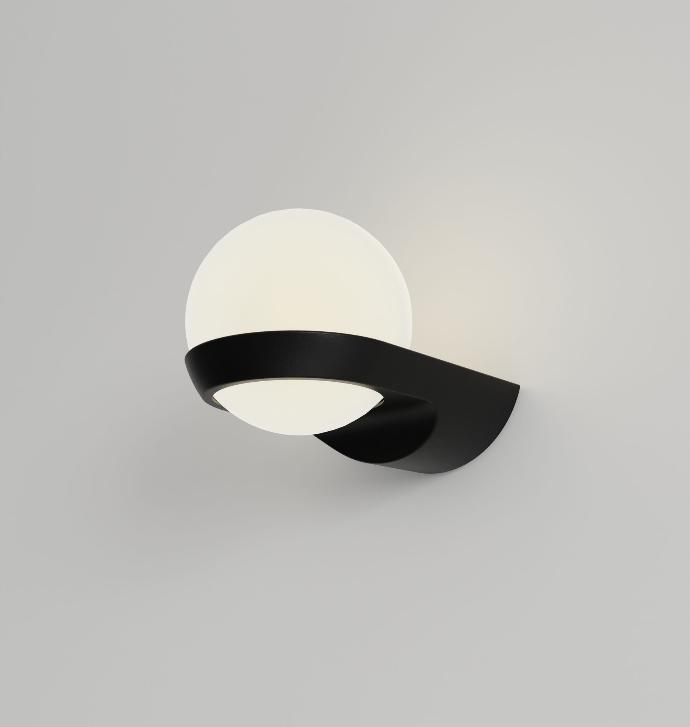
How KOMOT and Porzellanmanufaktur Reichenbach rethink craftsmanship, materiality, and the German Mittelstand.
At a time when products are increasingly manufactured globally and brands become interchangeable, two German manufactories are making a conscious statement: for origin, for material integrity—and for the strength of regional collaboration.
Collaboration begins where expertise is not purchased, but shared. The lighting manufacturer KOMOT and the traditional porcelain manufacturer Reichenbach have combined their capabilities to jointly develop the wall mount for the KOS NIDO—the new wall luminaire expanding the KOS collection.
What emerged is more than a component. It is the result of a dialogue on equal terms—between lighting technology and porcelain craftsmanship, between design intent and material expertise.

Porcelain as an architectural element
At the core of the development was a clear design idea: The opal glass sphere of the KOS should retain its characteristic expression even when mounted on the wall—reduced, precise, and self-contained.
The porcelain mount plays a deliberately restrained yet essential role: it supports, frames, and protects. It conceals the technical components. It gives the luminaire stability—and at the same time, a place.
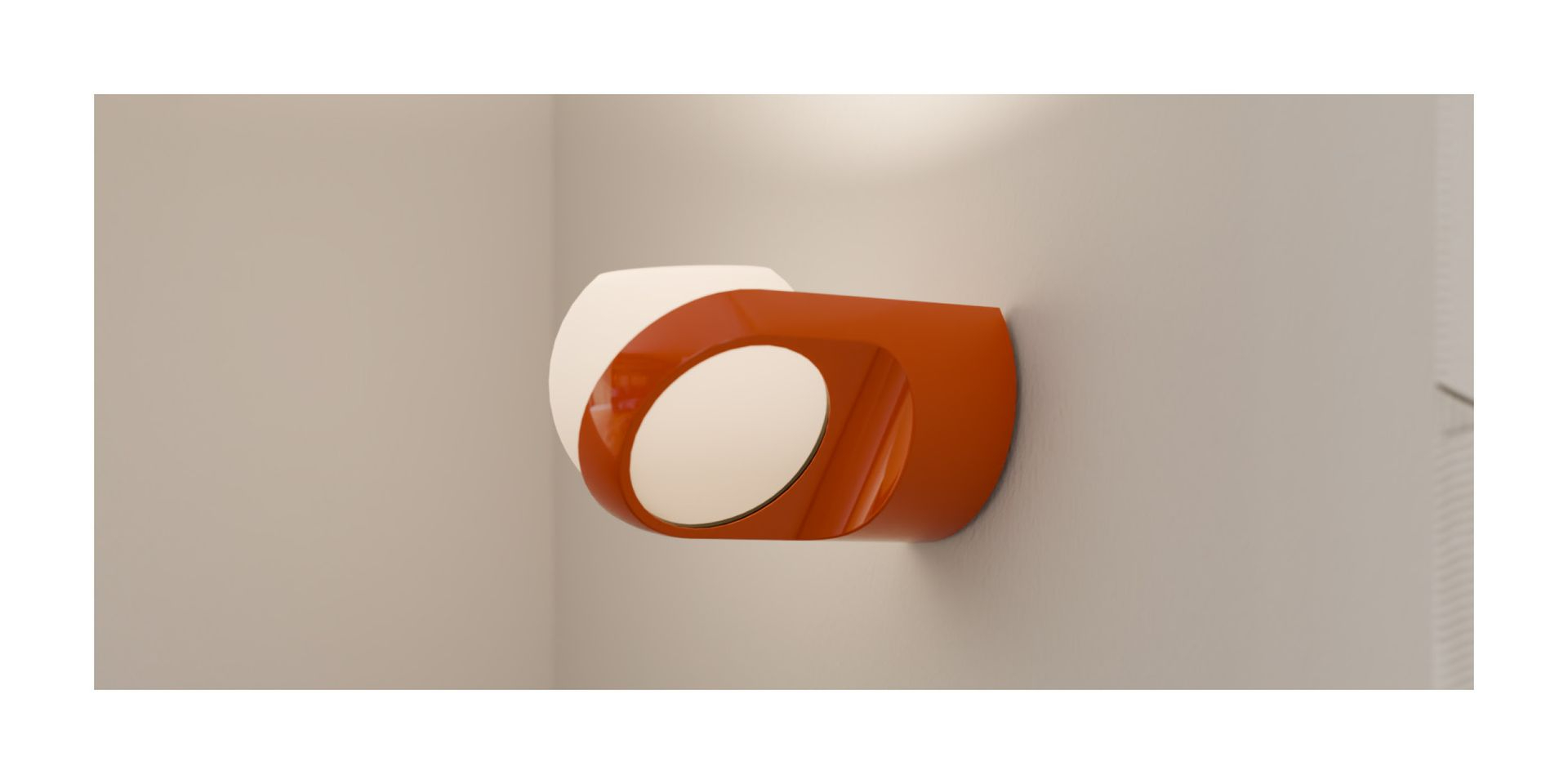
Unlike translucent porcelain objects, the focus here is not on light transmission. At the chosen material thickness, the porcelain does not allow light to pass through. Instead, it functions as an architectural body that houses the technology and sets the opal glass sphere free.
The name “NIDO”—Italian for “nest”—describes this principle precisely: The mount forms the protected frame in which the light can unfold.
Precision in motion
The KOS NIDO impresses not only with its formal clarity but also with its sophisticated technical design.
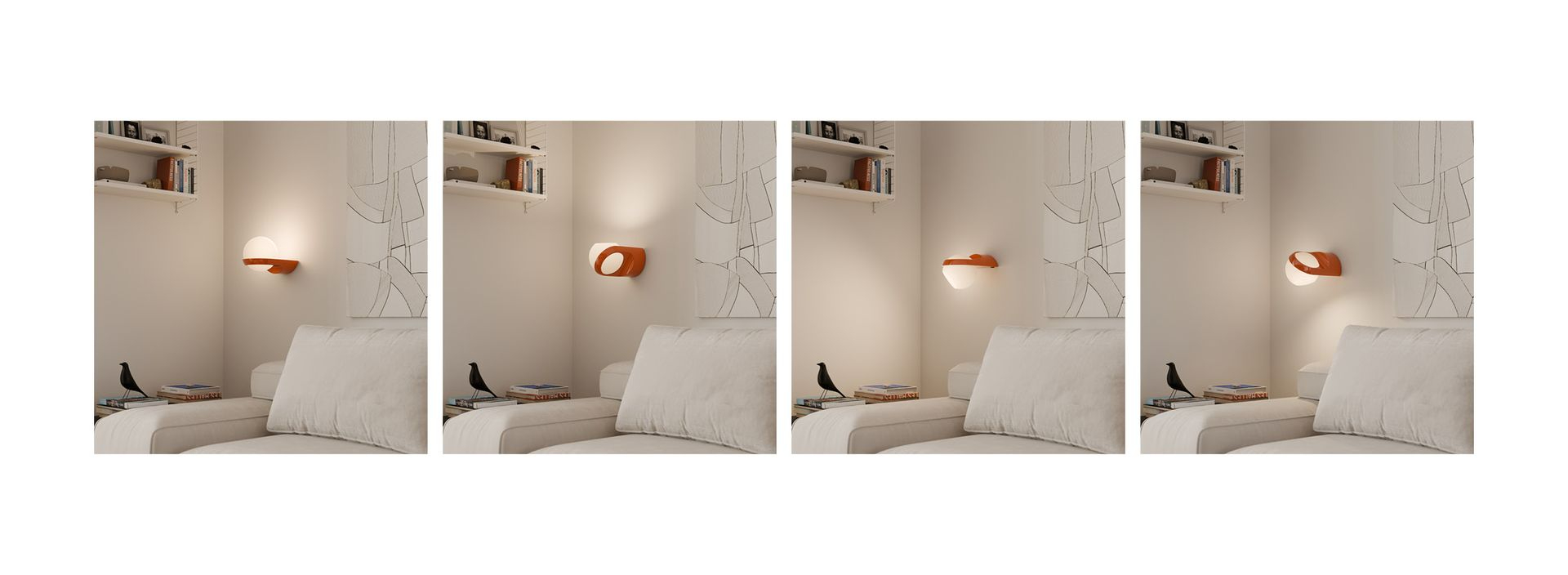
The opal glass sphere is positioned at a 45° angle within the porcelain mount—carefully balanced between stillness and motion. Two integrated slip rings, invisible from the outside, allow the sphere to rotate endlessly by 360° within its mount. This enables precise light alignment without exposing cables or technical elements.
The porcelain mount itself is also movable: it can be rotated freely on the wall. In an instant, a subtle wall light transforms into a directional reading light or an accent spotlight for objects and art.
“It was important to us that the luminaire is not conceived as static,” explains co-designer Luca Brand. “The KOS NIDO should naturally adapt to different usage scenarios—intuitively, without technical dominance. Movement is part of the design.”
Like all luminaires in the KOS collection, the NIDO is intelligently conceived: the integrated KOS CONNECT module allows flexible adjustment of brightness and color temperature via app—tailored to time of day, usage, and atmosphere.
In this way, the KOS NIDO combines crafted materiality with technical sophistication—visually reduced, functionally versatile.
Development as a shared process
The collaboration between KOMOT and Reichenbach is not driven by short-term trends, but by a long-term ambition: to rethink manufactory work. Both companies share a clear design philosophy, a high level of in-house production, regional manufacturing, and a commitment to the Mittelstand.
Reichenbach contributed its extensive expertise in porcelain processing, advising on materiality, proportion, and production, and played a key role in the constructive development of the wall mount.
“With a material like porcelain, feasibility is determined by experience,” says Konrad Weinhuber, founder and managing director of KOMOT. “The openness and courage to explore new paths were essential to developing the KOS NIDO. When light meets porcelain, the result is not a compromise, but a new field of tension.”
Reichenbach also sees the collaboration as a conscious commitment to interdisciplinary exchange:
“Tradition remains alive only when it is brought into new contexts—without losing its substance.” 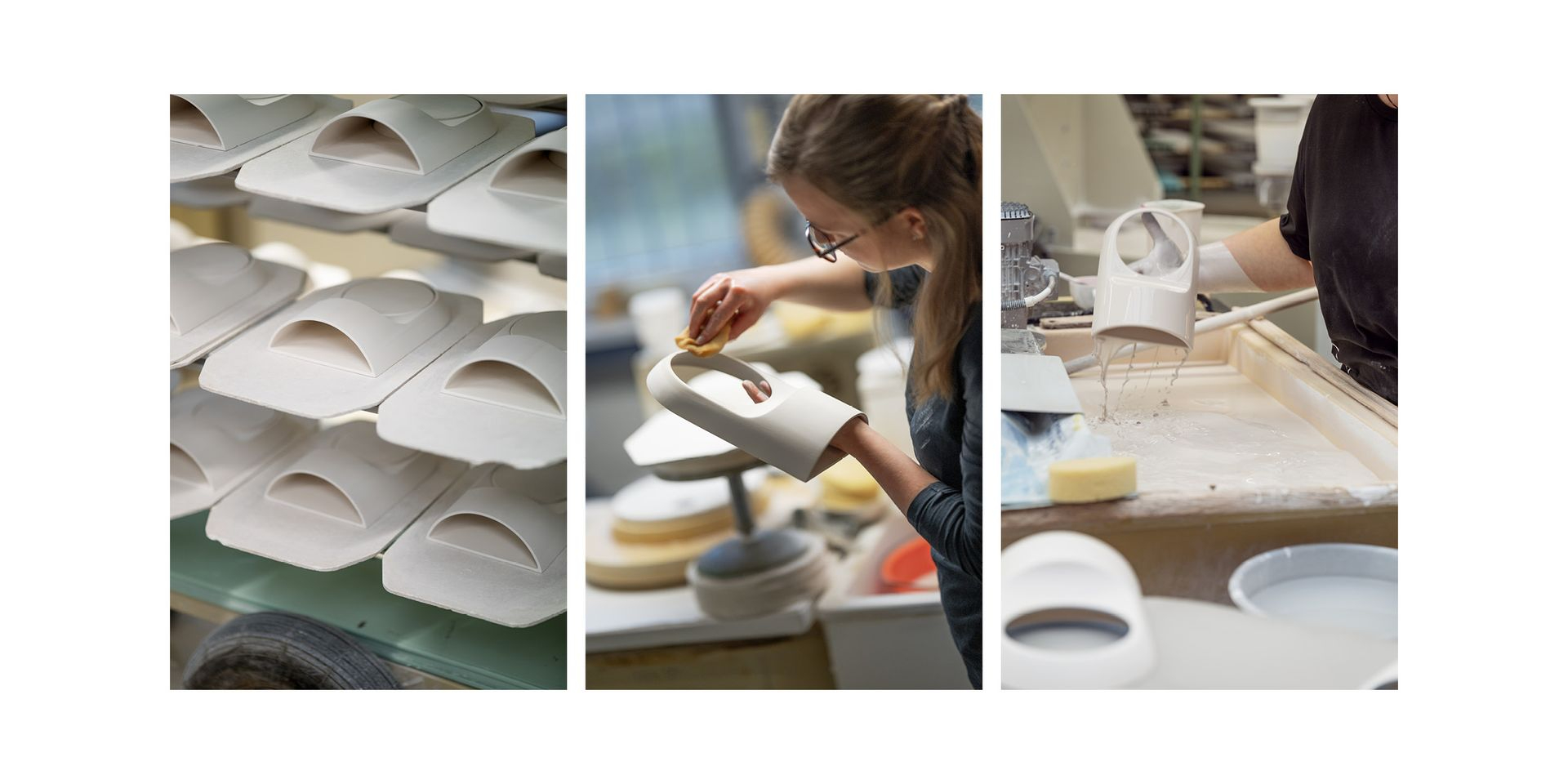
The regional Mittelstand as a space for innovation
This collaboration exemplifies a strength that is often underestimated: the innovative power of owner-managed manufactories. It demonstrates how domestic value chains can not only be preserved but actively shaped—as an alternative to anonymous mass production. Short distances, direct coordination, and joint prototype development enabled rapid iterations and precise solutions. The result is a wall mount that is technically convincing and feels naturally integrated—as if it had never been conceived any other way.
The KOS NIDO is therefore more than just an extension of a collection. It is an expression of a design philosophy built on exchange. Material is not used decoratively, but conceived constructively. Craftsmanship is not romanticized, but understood as a development partner. Collaboration is not about addition, but about deepening.
Premiere at Munich Design Days 2026
KOMOT will present the KOS NIDO at Munich Design Days from March 12–15, 2026, on Praterinsel in Munich. The event is considered a platform for curated design, high-quality manufactory work, and interdisciplinary exchange. In this context, the new wall luminaire will be introduced to a professional audience from architecture, interior design, and retail as part of the KOS collection.
About KOMOT
KOMOT is a Munich-based lighting manufacturer that understands light as a defining element in space. With a high level of in-house production, precise engineering, and a clear understanding of materials, the company creates luminaires that combine function and atmosphere.
About Porzellanmanufaktur Reichenbach
Porzellanmanufaktur Reichenbach stands for excellence in porcelain craftsmanship. The company combines traditional manufacturing techniques with contemporary design and supports projects with deep material expertise.